
The Librarian
Esta página aún no está disponible en español. Se muestra la versión en inglés.
Most people with a business question don’t want to learn where the data lives before they can ask it. The Librarian is the assistant that works from your Library: you ask in plain English, it works out what the Library already knows, and it answers in a way you can check.
The idea
Section titled “The idea”Using Querri comes down to this: open it, ask a question, get an answer. The Librarian is who you’re asking. You talk to it in Librarian chat, the panel docked beside the Library, the Inbox, and your lists of projects and dashboards. (Open a project chat and the same panel talks to that project instead.)
It works from what your Library holds: the raw tables from your sources, plus the collections, questions, views, KPIs and facts built on top of them. So it gets more useful as the Library fills in.
What does it actually do with a question? Quite a bit more than answer it.
It answers, and shows its work
Section titled “It answers, and shows its work”The Librarian looks for a view or KPI that already answers the question, and if nothing fits, it queries your source tables. Every answer shows what it read from, the rows it got back and the query that produced them. If the data isn’t there, you’ll see Query declined instead of a made-up number. How Querri answers a question goes through it step by step.
Replies usually lead with the answer, then mention what the Librarian noticed along the way, like missing values or a question that reads two ways. That’s the usual shape, not a promise.
It adds to your Library
Section titled “It adds to your Library”It can create collections, KPIs and views, and change how a KPI is measured when you say the definition is off. When a conversation settles a business rule or turns up a data-quality problem, it records a fact, with no separate approval step. Saving a table it built as a view is your call.
Querri can’t know your business on its own. Companies compute revenue differently, so there’s no universal definition to fall back on, and the Librarian may pick a measure you’d define another way. Fixing that takes a conversation. The meaning stays yours.
It knows when a question needs more
Section titled “It knows when a question needs more”Quick lookups stay in chat. For a trend, a comparison across several cuts, a chart, a forecast or a root cause, the Librarian gives a short answer and offers a This needs a project card with Create project and Not now. Nothing is created until you confirm.
It moves your screen as it answers
Section titled “It moves your screen as it answers”The Librarian opens pages, changes views in the Library and edits the dashboard you have open, as part of answering. Each move shows as a line in the chat, so you can see what it did. There’s no setting for this in Querri; only an embed can turn it off. See Chat and the Librarian.
An example
Section titled “An example”You’re deciding what Curio should reorder this week, and you want stock by warehouse first. In Librarian chat you ask, “What is our current finished-goods inventory by warehouse?”
Curio’s Products & Inventory collection already has a view called Current finished-goods inventory by warehouse, so the Librarian reads from it. You get one row each for WH-CANADA, WH-EAST, WH-EU and WH-WEST, and the answer names the view the numbers came from.
Then someone asks, “How many support tickets did we close last month?” Curio has never connected a helpdesk, and the reply says Query declined. Good. Any number there would have been confidently wrong.
Where it lives in Querri
Section titled “Where it lives in Querri”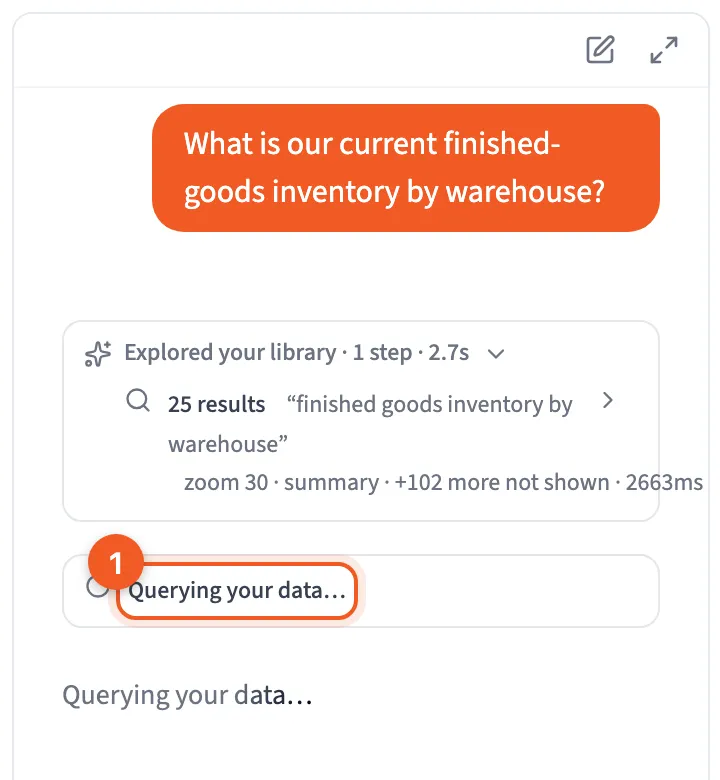
- Querying your data…: the Librarian is running a query. When it finishes, the answer, its rows and its query appear in the same place.
Start a conversation with New chat on the rail, or type into the chat panel beside the Library. History on the rail lists your past chats, and every Library detail panel has an Ask about this button for its kind (see Detail panels).
Each message you send counts once toward your credits as a question asked in the Library, however many lookups the answer takes.